Lowest Consumer Sentiment Ever

Posted by
Cognizant Wealth Advisors
Category
Economy
Posted on
The Consumer Sentiment Index recently fell to one of the lowest readings on record. What does that mean?¹
In case you're not aware of it, the CSI is an indicator of how optimistic or pessimistic consumers are about the economy and their own personal financial situation. Created by the University of Michigan in the late 1940s, it is calculated monthly based on surveys of approximately 500–1,000 American households designed to be representative of the broader population.² Scores above 100 generally indicate relatively strong consumer confidence, while lower readings indicate weaker sentiment.²
Why is it considered important? Changes in consumer sentiment may provide insight into future consumer spending trends and broader economic conditions. When consumers feel confident, they are generally more willing to spend, while rising costs for necessities such as food and fuel can weigh on spending decisions. Consumer spending accounts for approximately two-thirds of U.S. gross domestic product, making it a significant driver of economic activity.³
The graph below from the St. Louis Federal Reserve shows the CSI since 1980. The index fell to 44.8 last month, among the lowest readings ever recorded and below the previous trough reached during the inflation surge of 2022.¹
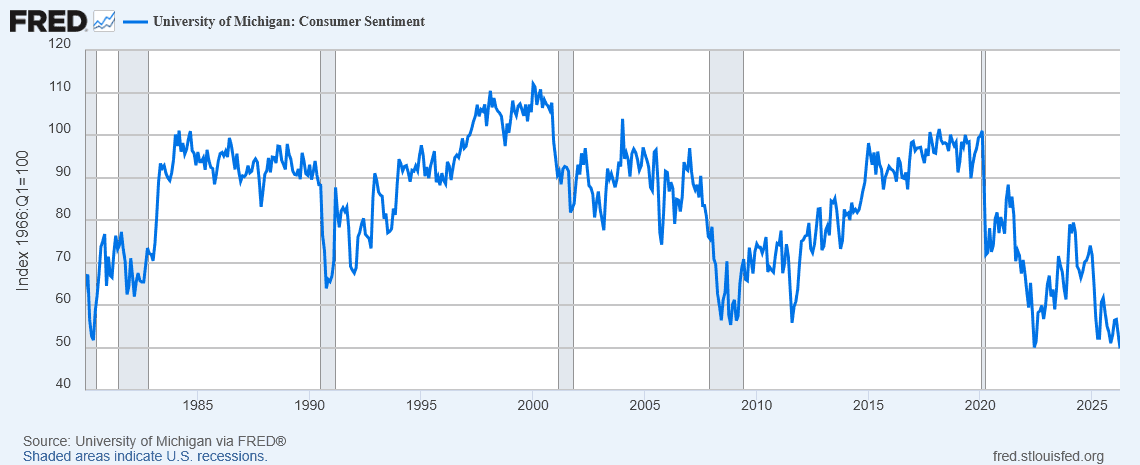
You can see that there has been a decline in consumer sentiment during each recession (the shaded areas on the graph). However, sentiment has not always served as a leading indicator of recessions, and significant declines have also occurred during periods that were not officially classified as recessions, including 2012 and 2022.¹
What are some of the causes? As with investment returns, many factors may influence consumer sentiment. Elevated inflation is a likely contributor, given similar declines during previous periods of high inflation, including the early 1980s and 2022.¹ Political affiliation may also play a role. The University of Michigan publishes sentiment data segmented by political party, with available data extending back to 2017.⁴
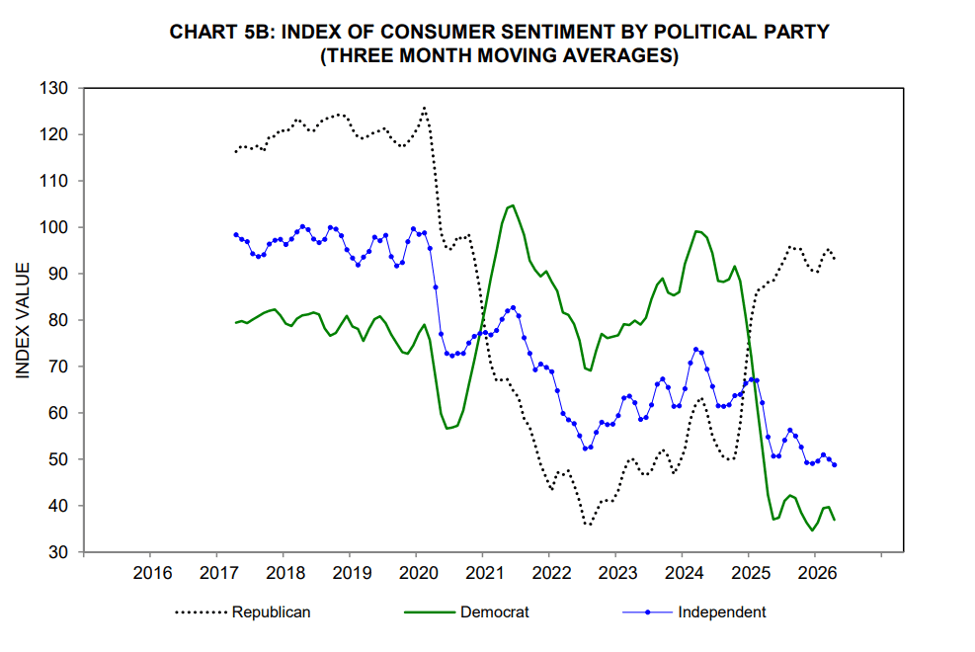
Supporters of the political party in power have generally reported higher levels of confidence in economic conditions than supporters of the opposing party.⁴ However, recent data show historically low confidence levels among Democrats and Independents, while Republican sentiment has remained below the optimistic range seen during portions of 2017–2020.⁴
In any case, if consumer spending were to decline significantly, it could contribute to slower economic growth or a recession and potentially lead to increased market volatility. However, the timing, magnitude, and duration of any such developments remain uncertain. This is one of many factors contributing to uncertainty in capital markets today.
Footnotes
¹ Federal Reserve Bank of St. Louis, FRED Economic Data, University of Michigan: Consumer Sentiment (UMCSENT). Available at: https://fred.stlouisfed.org/series/UMCSENT
² University of Michigan, Surveys of Consumers: Survey Description and Methodology. Available at: https://data.sca.isr.umich.edu/survey-description.php
³ U.S. Bank, "Consumer Spending and the U.S. Economy." Available at: https://www.usbank.com/investing/financial-perspectives/market-news/consumer-spending.html
⁴ University of Michigan, Surveys of Consumers: Consumer Sentiment by Political Party. Available at: https://data.sca.isr.umich.edu/charts.php
Related Post

Some random description of the blog that will keep the area filled with this description which is very obvioously fake description.

Some random description of the blog that will keep the area filled with this description which is very obvioously fake description.

Some random description of the blog that will keep the area filled with this description which is very obvioously fake description.